Why Should You Read More Fiction in 2022?

“Reading fiction is important. It is a vital means of imagining a life other than our own, which in turn makes us more empathetic beings. Following complex storylines stretches our brains beyond the 140 characters of sound-bite thinking, and staying within the world of a novel gives us the ability to be quiet and alone, two skills that are disappearing faster than the polar ice caps.”
—Ann Patchett

I feel like there’s a perception that in order to be well read, particularly in the world of leadership and personal development, you should only read nonfiction. Many people with voracious reading habits commonly make the same mistake: They hardly, if ever, read fiction. Some of them even brag about it! I mean we can all probably find a productivity bro that proudly says they haven’t read fiction since they were forced to in high school.

It wasn’t until bschool where I took a course called Leadership Through Fiction, that I realized how powerful fiction reading can be. I remember sitting among skeptical MBA candidates while we read What Makes Sammy Run, and watched Game of Thrones. That was reenforced when I took Ryan Holiday’s Read to Lead course and an entire module was devoted to fiction.

Too many people want to know the secret sauce of the successful. They want to know exactly how this or that billionaire made it, want the “real” stuff. Hell, even I’m guilty of proclaiming that a nonfiction book allows you to download decades into days.

The characters in fiction look nothing like what we know? We’re too busy to waste time reading about yearning, and feelings, and complex experiences, and all that stuff. We can’t justify sitting down and trying to make it through the plays of Shakespeare. Where are the “takeaways”??? How do I possibly make Romeo & Juliet actionable for my business??? The Invisible Man can’t teach me how to increase my conversion rate.

We’re kidding at this point, of course, but the larger point remains the same: people will twist themselves into knots to find an excuse for why they don’t read fiction. Why they don’t need to. And they’re all nonsense.

“I’ve never read a novel. That kind of reading annoys me.”
—Adolf Hitler (super glowing endorsement to shun fiction right?)

Fiction is where the real knowledge is! Great novels, like all wonderful art, are filled with little bits of insight about the human condition that are worthy of pulling out and thinking on. Fiction can change your life and teach you just as much as any non-fiction book. Like Fran Leibowitz said, a book should be a door, not a mirror! Oh and fellas, I promise you if you pick up a romance novel you’ll start to get an idea of what women want, or at the very least book tok will help you understand why we’re all looking for Mr. Darcey, or a werewolf bad boy in the mafia (women…we’re complex creatures).

Some of the greatest philosophers looked to works of fiction. Seneca liked to quote the works of the great Roman poets Virgil and Lucius Accius, the legendary Homer, the playwright Plautus. He also wrote many brilliant plays himself, plays that anyone who would like to understand Seneca’s philosophy on a deeper level, ought to read.

Ryan Holiday has the perfect words (as always):

Fiction offers writers and thinkers a forum for expressing their ideas in their purest and most concentrated forms. These great minds knew the power that resides within works of fiction, thousands of years before the research proved it:

  • Multiple studies have shown that imagining stories helps activate the regions of your brain responsible for better understanding others and seeing the world from a new perspective. When the psychologist Raymond Mar analyzed 86 fMRI studies, he saw substantial overlap in the brain networks used to understand stories and the networks used to navigate interactions with other individuals.
  • A 2013 Emory University study compared the brains of people after they read fiction to the brains of people who didn’t read. The brains of the readers showed more activity in certain areas than those who didn’t read—especially the left temporal cortex, the part of the brain typically associated with understanding language. The website testyourvocab.com analyzed millions of its test-takers to discover that fiction readers were significantly more likely to have a larger vocabulary.

In his book Such Stuff as Dreams: The Psychology of Fiction, cognitive psychologist Dr. Keith Oatley argues that fiction is a simulation for the social world. Just like your understanding of starting a company or a meditation practice is improved by reading books on the subject, reading fiction improves your understanding of social relationships. It improves your ability to step into someone else’s shoes and think about what other people might be thinking. In fact, Dr. Oatley says it allows you to experience a variety of social circumstances and explore alternate states of mind from a wide variety of people that you otherwise can’t always interact with in your typical day-to-day life.

As the great multi-genre author Neil Gaiman likes to say, “Fiction gives us empathy: it puts us inside the minds of other people, gives us the gifts of seeing the world through their eyes. Fiction is a lie that tells us true things, over and over.” So whether it be for mere entertainment or for self-improvement, pick up a work of fiction today and get lost in the imagined world—it just may help you better understand the real one.

If you’re coming around to the idea of adding more fiction, or picking up a novel in 2022, here are some of my favorite fiction reads from 2021 with links so you can add them to cart now (full disclosure, not all of these are new releases, some are backlisted books I finally picked up this last year):

Like always, if you made it this far enjoy a video on the topic that I think you’ll like…

WTF is 4th space?

When I was at Columbia Business School I participated in the block week masterclass for the Luxury Education Foundation (LEF).

The Luxury Education Foundation is a non-profit organization focused on nurturing future leaders in the luxury industry and fostering meaningful exchanges between like-minded CEOs, leading executives and high-potential, emerging talent. Established in 2004, LEF partners with Columbia Business School, Parsons School of Design, and Hong Kong University of Science and Technology to create global, qualitative interdisciplinary programs to ensure future success for members, students, and alumni.

Thanks to reasonable dues I still get to participate in different roundtable discussions. And surprisingly, thanks to the push to remote events, I’m still able to attend speaking events in LA.

Most recently there was a Think Tank discussion on technology in fashion.

I found the conversation so incredibly valuable, and truthfully I haven’t stopped talking about Web3 topics since 2017 in bschool. I think the metaverse conversations are fascinating. Don’t get it twisted though, I don’t understand blockchain, or NFTs. But as a gamer, I can recognize that all of this started in gaming. And like a nerd forward sequel to Devil Wears Prada, the decisions made in publishers offices have trickled down to the fashion industry.

Technology and the pandemic have changed personalization. I think as Web3 evolves the questions we, in the fashion industry should ask ourselves, “how do brands stay relevant in the metaverse?” and “how will marketing change in the metaverse?” As a digital marketer that last one is the million dollar question. It’s the wild west in the metaverse, and whoever can identify strategic priorities first will be the “expert” everyone turns to.

What the metaverse is going to open up is the 4th space, the melding of the physical and digital world. And the investments are there, we’re already seeing brands buying up digital real estate, or acquiring brands that know there way around 4th space, case in point Nike acquiring RTFKT.

What do I think will be the first steps to finding some kind of footing as a marketer in the metaverse. I think the panelists on the LEF Think Tank said it best, psychographics will matter. As the market becomes more global you’re going to need to understand subcultures, what makes the customer tick on a human level. Model and futurist Sinead Bovell said it best, as tech becomes more ubiquitous to our world, it’s the human connection/EQ element that will make you invaluable. I don’t think we all need to dive in understanding behavioral science, but I do think that we’ll need to go beyond campaign execution and start figuring out how to make an emotional connection with the audience.

We’re a social first, digital society, or at least we’re getting there, and I can’t wait to keep learning more, sharing with you all, and diving into how all of this isn’t just impacting the fashion industry, but entertainment, unique partnerships, and all the other little bits.

Like always, if you made it this far, I wanted to share some things I’ve enjoyed around the topic.

What to Do When Your Neurodivergent Brain Just Won’t Go

To say I had writers block for this week’s blog post is an understatement.

As I’ve grown to embrace my neurodivergence over the last few years (and honestly I have Tik Tok to thank for allowing me, at my big age to not feel so alone), I’ve realized that there are days like this. Days where I sit down and my executive function fully fails me. It’s like task paralysis, I just can’t get my brain to go.

My aim with coming back to blogging was to provide value to readers. I guess the value I’m providing today is helpful for the other ADHD folks who think they’re alone in these moments. The moments where you sit down to work and absolutely nothing happens, and you feel like you’re failing. Or maybe those moments you sit through a lecture only to feel like you would have been better off never going, because absolutely nothing made sense to you. Or even looking down the barrel of weekend tasks and not having the ability to get started.

I’ve been lucky on my ADHD journey to find some influencers who have helped me finally put words to these moments…honestly there’s an influencer for everything.

If you have a task ahead of you, are neurodivergent, and can’t get going, hopefully these videos help you feel less alone like they did for me…

How to Remember What You Read…a case for the commonplace

What is a commonplace book. By definition a commonplace book is, a book into which notable extracts from other works are copied for personal use. I love how Austin Kleon refers to it as a “swipe file” in his writing.

A commonplace book is a depository for ideas, quotes, anecdotes, observations, and information that you come across during your life in the course of reading, observing, or other didactic pursuits. The purpose is to record and organize information that strikes you, quotes that motivate you, stories that inspire you for later use in your life, in your business, in your writing, in your speaking, or whatever it is that you do.

I have Ryan Holiday (like many things in my life) to thank for learning about this process.

Often times when you read a lot, there’s an assumption that you don’t retain a lot of what you read, and since learning about the commonplace book, it’s been incredibly helpful in regards to retaining and connecting what I read.

But aside from helping me retain what I read, the commonplace has held an important place in the world of “learned people” (please read that in the voice of John C. Reilly in Stepbrothers).

Courtesy of Ryan Holiday in the Read to Lead Challenge:

“From his days as spokesperson for General Electric in the 1950s, through his presidency in the 1980s, and until his death in 2004, Ronald Reagan, dubbed ‘The Great Communicator,’ delivered thousands of speeches and some of history’s greatest public addresses. How did he do it? He had a secret weapon that would only be discovered after his death.

In 2010, when the Reagan Presidential Library was undergoing renovation, a box labeled ‘RR’s desk’ was discovered. Inside the box were the personal belongings Reagan kept in his office desk, including a number of black boxes containing 4×6 note cards filled with handwritten quotes, thoughts, stories, political aphorisms, and one-liners. Distinguished by themes like ‘On the Nation,’ ‘On Liberty.’ ‘On War,’ ‘On the People,’ ‘The World,’ ‘Humor,’ and ‘On Character’—this was Reagan’s version of a commonplace book.”

My commonplace has taken many different manifestations, all for the sake of trying to find what works.

I’ve tried notecards.

Note pages.

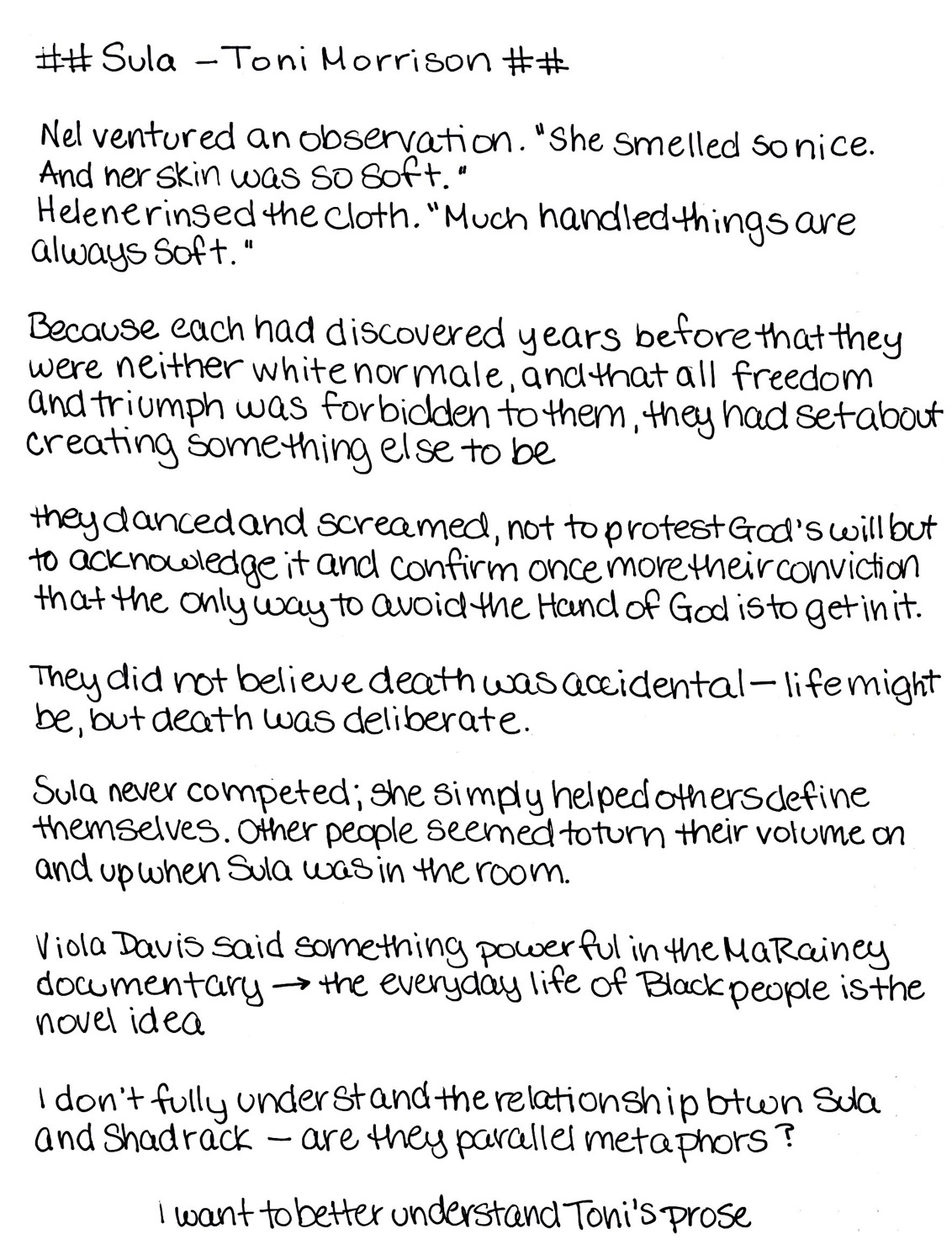
Rocket notebook write up on Sula, by Toni Morrison

And “capture and create” method.

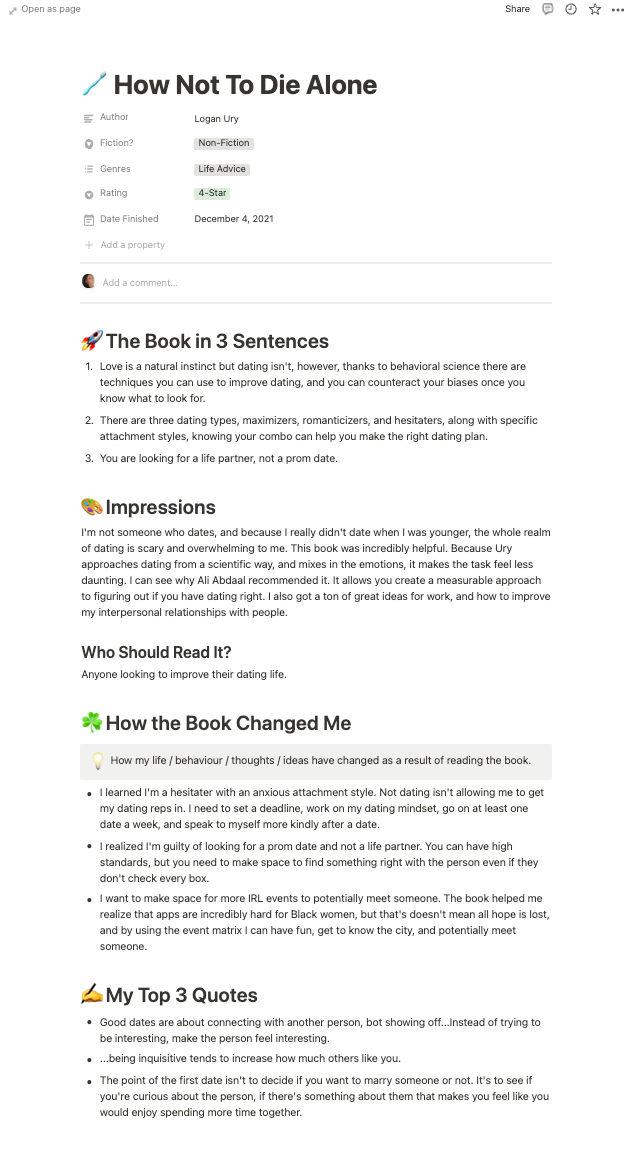
Recently, and what’s proven to be super effective, using Notion. The fact that I’m even using Notion feels like a cliche of all the productivity folks on YouTube, but I swear they aren’t full of it. As you can tell from the examples above, I’m often feast or famine. I tend to write everything down to a point that I’m writing a mini version of the book, or it’s a notecard without the context.

My current Notion system often looks like the below…

I cannot speak highly enough about this book – thanks Ali Abdaal on recommending it on your YouTube!

My challenge to you is to start keeping a commonplace book.

Commit to drawing from multiple sources: fiction and nonfiction, magazine articles, poems, even pertinent quotes from TV shows or movies. If you don’t find anything in your current content multiple days in a row, consider discarding it and picking something new. Think of specific topics you want to cover, example, devote the next ten pages of your book to leadership (something I’m working on in the new year, dedicated pages toward a single topic, rather than book by book).

I’m always reading with a pen, or highlighter, and some page flags in hand. I’m also not opposed to folding pages. Books are meant to be read, interacted with, so don’t be afraid to have a dialogue with the author, and look for bits to transfer to your commonplace book.

The first time I read Meditations by Marcus Aurelius, I was blown away when I learned that we were basically getting a peak into his commonplace book. So if it helps, think of a commonplace book that you’d want to leave for your kids and grandkids…they’ll know where you drew inspiration.

The Roman author and philosopher Seneca said it brilliantly:

“We should hunt out the helpful pieces of teaching and the spirited and noble-minded sayings which are capable of immediate practical application—not far-fetched or archaic expressions or extravagant metaphors and figures of speech—and learn them so well that words become works.”

Since you’re still here, enjoy these two videos on the topic…